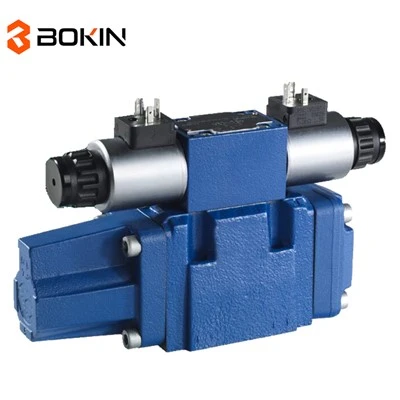
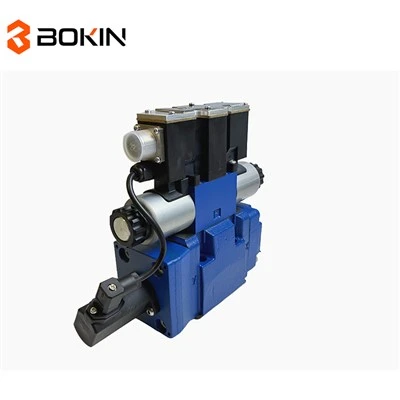
As a supplier of proportional directional valves, I've often been asked whether these valves can be used in automotive applications. This question is crucial as the automotive industry is constantly evolving, and the demand for more efficient, precise, and reliable components is ever - increasing. In this blog, I'll delve into the details of proportional directional valves and their potential in automotive applications.
Understanding Proportional Directional Valves
Proportional directional valves are a type of hydraulic valve that can control the flow rate and direction of hydraulic fluid in a proportional manner. Unlike traditional on - off valves, which only have two states (open or closed), proportional directional valves can vary the flow rate continuously based on an input signal. This allows for more precise control of hydraulic systems, which is essential in many applications where fine - tuned adjustments are required.
The basic principle behind proportional directional valves is the use of an electrical input signal to control the position of a spool inside the valve. The spool movement determines the amount and direction of fluid flow. By adjusting the input signal, the operator can precisely control the flow rate, which in turn affects the speed and force of hydraulic actuators.
Advantages of Proportional Directional Valves
- Precise Control: One of the main advantages of proportional directional valves is their ability to provide precise control over hydraulic systems. In automotive applications, this can be used to control the movement of various components such as steering systems, suspension systems, and braking systems. For example, in a power steering system, a proportional directional valve can adjust the amount of hydraulic pressure applied to the steering mechanism based on the steering input, providing a more responsive and comfortable driving experience.
- Energy Efficiency: Proportional directional valves can help improve energy efficiency in hydraulic systems. By adjusting the flow rate according to the actual demand, they can reduce the amount of energy wasted in the system. In automotive applications, this can lead to lower fuel consumption and reduced emissions.
- Flexibility: These valves offer a high degree of flexibility in system design. They can be easily integrated into existing hydraulic systems and can be programmed to meet specific requirements. This makes them suitable for a wide range of automotive applications, from small passenger cars to large commercial vehicles.
Potential Automotive Applications
- Steering Systems: Proportional directional valves can play a crucial role in power steering systems. They can adjust the hydraulic pressure applied to the steering mechanism based on the speed of the vehicle and the steering input. At low speeds, more hydraulic pressure can be provided to make steering easier, while at high speeds, less pressure can be applied to provide a more stable driving experience. For example, in a modern electric power steering system, a proportional directional valve can be used to control the flow of hydraulic fluid to the steering rack, allowing for precise control of the steering force.
- Suspension Systems: In automotive suspension systems, proportional directional valves can be used to adjust the damping force of shock absorbers. By controlling the flow of hydraulic fluid in the shock absorbers, these valves can provide a more comfortable ride by adapting to different road conditions. For instance, on a rough road, the valve can increase the damping force to reduce the vehicle's bounce, while on a smooth road, it can decrease the damping force for a more comfortable ride.
- Braking Systems: Proportional directional valves can also be used in automotive braking systems. They can control the distribution of hydraulic pressure to the brakes on each wheel, providing better braking performance and stability. In an anti - lock braking system (ABS), a proportional directional valve can adjust the pressure in each brake cylinder to prevent the wheels from locking up during sudden braking.
Our Product Range
We offer a wide range of proportional directional valves that are suitable for automotive applications. Some of our popular products include:
- Pilot - Operated Hydraulic Directional Valve 4WRTE32 A1 10V Control: This valve is designed for high - flow applications and provides precise control over the flow rate and direction of hydraulic fluid. It is suitable for large - scale automotive systems such as heavy - duty trucks and buses.
- Pilot - Operated Hydraulic Directional Valve 4WRTE25 A1 10V Control: This valve is a mid - sized option that offers a good balance between performance and cost. It is suitable for a wide range of automotive applications, including passenger cars and light - duty trucks.
- Pilot - Operated Hydraulic Directional Valve 4WRTE10 A1 10V Control: This valve is designed for low - flow applications and is ideal for small - scale automotive systems such as motorcycles and electric vehicles.
Challenges and Considerations
While proportional directional valves offer many advantages in automotive applications, there are also some challenges and considerations that need to be taken into account.


- Cost: Proportional directional valves are generally more expensive than traditional on - off valves. This is due to their more complex design and the need for precise control components. However, the benefits of improved performance and energy efficiency can often outweigh the higher cost in the long run.
- Maintenance: These valves require more maintenance compared to traditional valves. The precision components inside the valve can be sensitive to contaminants in the hydraulic fluid, and regular maintenance is required to ensure their proper operation.
- System Integration: Integrating proportional directional valves into existing automotive systems can be challenging. It requires a good understanding of hydraulic systems and electrical control systems. Proper installation and calibration are essential to ensure the valve operates correctly and provides the desired performance.
Conclusion
In conclusion, proportional directional valves have great potential in automotive applications. Their ability to provide precise control, improve energy efficiency, and offer flexibility in system design makes them a valuable component in modern automotive systems. Our range of proportional directional valves, such as the Pilot - Operated Hydraulic Directional Valve 4WRTE32 A1 10V Control, Pilot - Operated Hydraulic Directional Valve 4WRTE25 A1 10V Control, and Pilot - Operated Hydraulic Directional Valve 4WRTE10 A1 10V Control, are designed to meet the specific requirements of the automotive industry.
If you are interested in using proportional directional valves in your automotive applications, we invite you to contact us for further discussion and to explore how our products can meet your needs. Our team of experts is ready to assist you in finding the right solution for your automotive hydraulic systems.
References
- Fluid Power Handbook, various authors
- Automotive Hydraulic System Design and Analysis, industry publications