How a hydraulic valve connects to the system affects maintenance accessibility, leakage risk, and overall machine footprint. Five mounting types are commonly encountered in industrial equipment, each with distinct trade-offs.

Threaded connection (in-line mounting) is the simplest approach - the valve body has threaded ports that connect directly to hydraulic pipes and fittings. This method requires no manifold block and is suitable for simple, low-cost equipment. However, the pipework becomes cluttered quickly in multi-valve systems, and each threaded joint is a potential leak point. Maintenance requires disconnecting individual pipes, often draining the entire circuit.
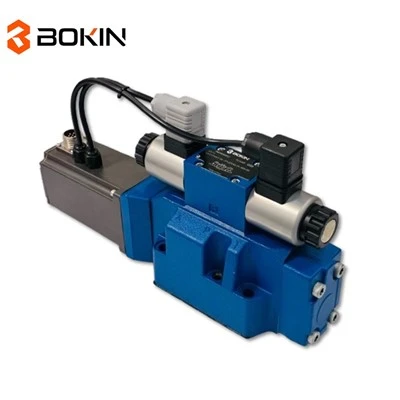
Subplate mounting solves the clutter problem by routing all connections through a machined manifold plate. Valves bolt onto the subplate surface, and all interconnecting passages are internal drillings within the plate. This configuration - the standard for ISO 4401-compliant Rexroth Type proportional directional valves and most industrial directional valves - provides clean valve layouts with minimal external piping. Valve replacement is straightforward: unbolt, replace, re-bolt without disturbing pipe connections.
Sandwich (modular) mounting is the evolution of subplate technology. Each valve module incorporates internal P, T, A, B through-passages, allowing functions to be stacked vertically between the directional valve and its subplate. A typical stack might combine a pilot-operated check valve, a pressure reducing valve, and a dual throttle check valve - all without additional manifolds or pipework. This modularity is particularly valuable for injection molding machines and press systems where hydraulic functions may change between product configurations.
Cartridge mounting embeds the valve sleeve and internal elements directly into a machined cavity in a manifold block. The result is extremely compact, capable of handling high flow rates, and resistant to external leakage since all connections are internal. Two-way cartridge valves (logic elements) using this format dominate large hydraulic power units, die casting machines, and metallurgical equipment where high flow and space constraints coexist.
For system designers, the mounting choice should consider not just initial cost but lifecycle maintainability - a valve that requires two hours to access for replacement costs far more over the machine's life than the purchase price difference. Standardized ISO 4401 and ISO 7368 interfaces ensure future interchangeability regardless of the original valve manufacturer.