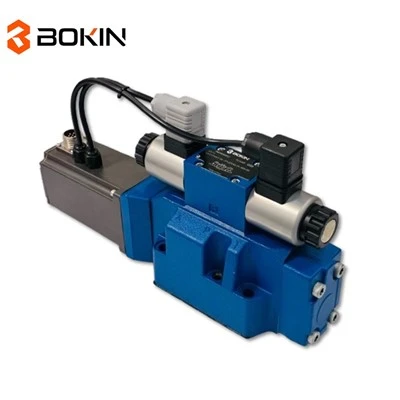
In hydraulic and pneumatic systems, smooth operation and precise control are always core requirements. Traditional on/off valves can only achieve binary control of "fully open/fully closed," which is insufficient to meet the demands of modern industry for complex motion trajectories, multi-stage pressure regulation, and efficient energy utilization. The emergence of proportional valves fills this technological gap-by linearly converting electrical signals into hydraulic or pneumatic parameters, they endow industrial equipment with the ability of "flexible control," becoming a crucial bridge connecting electrical control and mechanical action.
Before the advent of proportional valves, the control logic of hydraulic systems was extremely simple: when the solenoid valve was energized, the oil circuit was fully open, and the actuator moved at maximum speed; when de-energized, the oil circuit closed, and the movement stopped abruptly. This control method was applicable in early industrial scenarios, but as manufacturing has become more precise and intelligent, its limitations have become increasingly apparent. For example, injection molding machines require a smooth transition in the injection speed of molten plastic from a slow start to high-speed filling, while on/off valves can only simulate "pseudo-continuous" control through frequent on/off switching, leading to speed fluctuations and increased product defect rates.