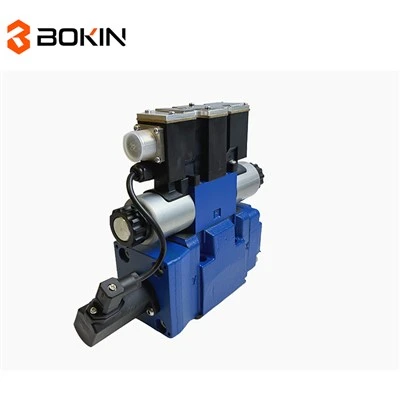
Hey there! As a supplier of Proportional Directional Valves, I've seen firsthand how the flow linearity of a valve can significantly impact system control. In this blog, I'll break down what valve flow linearity is, why it matters, and how it affects system control.
What is Valve Flow Linearity?
Let's start with the basics. Valve flow linearity refers to the relationship between the input signal (usually an electrical signal) and the output flow rate of the valve. In an ideal world, this relationship would be perfectly linear, meaning that a proportional increase in the input signal would result in a proportional increase in the flow rate.
For example, if you double the input signal, the flow rate should also double. However, in reality, most valves don't achieve perfect linearity. There are often non - linearities due to factors like valve design, internal friction, and the characteristics of the fluid being controlled.
Why Does Flow Linearity Matter?
Flow linearity is crucial for accurate system control. When a valve has good flow linearity, it's much easier to predict and control the flow rate. This is especially important in applications where precise control is required, such as in industrial automation, robotics, and hydraulic systems.
In a hydraulic system, for instance, if the valve's flow linearity is poor, it can lead to inconsistent performance. The system might not respond as expected to changes in the input signal, resulting in inaccurate movements or operations. This can cause problems like reduced efficiency, increased wear and tear on components, and even safety issues.
Effects of Valve Flow Linearity on System Control
1. Accuracy of Control
A valve with high flow linearity allows for more accurate control of the system. When the relationship between the input signal and the flow rate is linear, it's easier to set the desired flow rate precisely. This is essential in applications where tight tolerances are required, such as in the manufacturing of precision parts.
For example, in a CNC machining center, the hydraulic system needs to control the movement of the cutting tool with high precision. A Proportional Directional Valve with good flow linearity ensures that the tool moves exactly as commanded, resulting in high - quality finished products.
2. Stability of the System
Flow linearity also affects the stability of the system. A valve with poor linearity can cause fluctuations in the flow rate, which can lead to instability in the system. This is particularly problematic in systems that require a constant and stable flow, such as in some chemical processing applications.
When the flow rate is unstable, it can cause variations in the process parameters, leading to inconsistent product quality. In contrast, a valve with good flow linearity helps maintain a stable flow rate, ensuring the stability of the entire system.


3. Responsiveness
The responsiveness of a system is another aspect affected by valve flow linearity. A valve with high linearity can quickly and accurately respond to changes in the input signal. This is important in applications where rapid changes in flow rate are required, such as in emergency shut - off systems or high - speed machinery.
For example, in a hydraulic press, the valve needs to be able to quickly adjust the flow rate to control the force applied. A valve with good flow linearity can respond rapidly to changes in the input signal, allowing for precise and timely control of the press.
Our Proportional Directional Valves
At our company, we offer a range of Proportional Directional Valves designed to provide excellent flow linearity. Our valves are engineered with advanced technology to minimize non - linearities and ensure accurate and reliable system control.
One of our popular products is the Pilot - Operated Hydraulic Directional Valve 4WRTE32 A1 10V Control. This valve is known for its high flow linearity, which allows for precise control of the hydraulic system. It's suitable for a wide range of applications, from industrial machinery to mobile equipment.
Another great option is the Pilot - Operated Hydraulic Directional Valve 4WRTE25 A1 10V Control. This valve offers similar benefits in terms of flow linearity and is designed for applications where space is limited.
Conclusion
In conclusion, the flow linearity of a valve has a significant impact on system control. It affects the accuracy, stability, and responsiveness of the system. As a supplier of Proportional Directional Valves, we understand the importance of providing valves with high flow linearity to ensure optimal system performance.
If you're in the market for a Proportional Directional Valve and want to learn more about how our products can improve your system control, don't hesitate to reach out. We're here to help you find the right valve for your specific needs.
References
- Fluid Power Handbook, various authors
- Hydraulic System Design and Analysis, some experts in the field