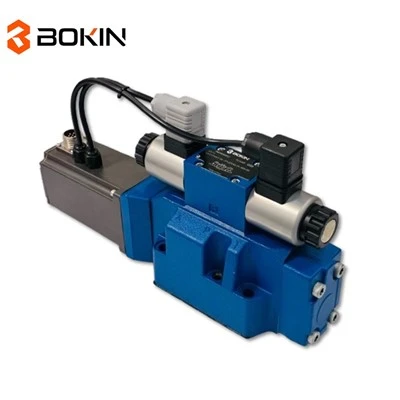
Digital servo-proportional valves enable closed-loop hydraulic control architectures that were previously the domain of dedicated servo valves. The ATOS DLKZOR's integrated LVDT position transducer and digital electronics provide the feedback foundation for precise motion and pressure control.

In position control mode, the valve receives a target position command from a motion controller. The controller compares the target against the actual cylinder position (measured by an external linear encoder or potentiometer), calculates the error, and sends a corrective signal to the valve. The valve's internal LVDT confirms the spool has moved to the commanded position. This dual-loop architecture - outer position loop around the cylinder, inner spool position loop within the valve - achieves the 0.01 mm positioning accuracy referenced in high-precision applications.
The zero-overlap spool design is critical here. Any overlap in the spool lands creates a dead zone where the valve produces no flow despite receiving a control signal. In a closed-loop system, this dead zone manifests as limit-cycle oscillation - the cylinder hunts back and forth around the target position. Zero overlap eliminates this behavior, allowing smooth, stable positioning even with high loop gains.
For pressure control applications - such as maintaining consistent clamping force in die casting or back pressure in injection molding - the valve regulates flow into a closed volume to achieve a target pressure. The LVDT feedback ensures the spool responds proportionally to small pressure deviations. The valve's fast step response (under 15 ms) allows the pressure loop to react quickly to load changes, preventing pressure spikes during mold filling or part ejection.
The DLKZOR supports different spool flow characteristics: linear (L), progressive (V), and non-linear (T). For general positioning tasks, the linear spool provides predictable flow-to-signal proportionality. For fine low-speed control at the beginning of motion, the non-linear T spool reduces initial flow gain, enabling smoother starting motion on heavy loads.