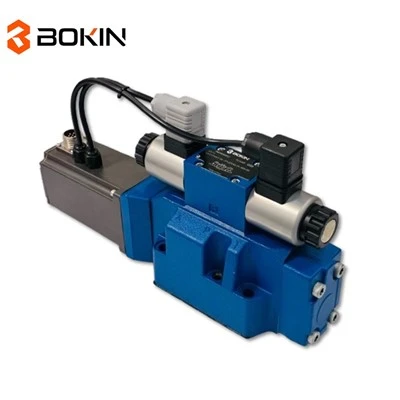
Evaluating a digital servo-proportional valve like the ATOS DLKZOR requires understanding which datasheet parameters translate to real-world performance. Several specifications distinguish high-performance valves from standard proportional units.

Response time measures how quickly the valve spool reaches a commanded position. For the DLKZOR, the step response from 0 to 100% input signal is typically under 15 ms. In closed-loop position or pressure control systems, this response speed determines the achievable loop bandwidth. A valve with 15 ms response can support control loops with update rates of 50-100 Hz - adequate for most industrial positioning tasks.
Hysteresis describes the difference in spool position when approaching the same command value from opposite directions. The DLKZOR achieves hysteresis of 0.1% of maximum regulation span. Low hysteresis is essential for applications requiring precise bidirectional control, such as servo press positioning or mold close synchronization in injection molding machines.
Repeatability, specified at ±0.1%, indicates how consistently the valve returns to the same position under identical command and load conditions. This parameter matters most in mass production processes where every cycle must match the previous one within tight tolerances.
Pressure ratings require careful interpretation. The DLKZOR carries 315 bar continuous pressure on the P, A, and B working ports, with 210 bar on the T return port. The maximum pressure limit reaches 350 bar on P, A, B ports under transient conditions. Long-term reliability, however, depends on maintaining working pressure 20-30% below the rated value - the same margin recommended for all high-pressure hydraulic pumps and valves.
Flow capacity must match system demand with margin. DLKZOR rated flows at Δp = 70 bar span 40 L/min, 75 L/min, and 130 L/min. Selecting a valve whose rated flow is 1.1-1.2 times the system's maximum flow requirement ensures the valve operates in its linear range rather than near saturation, where control accuracy degrades.